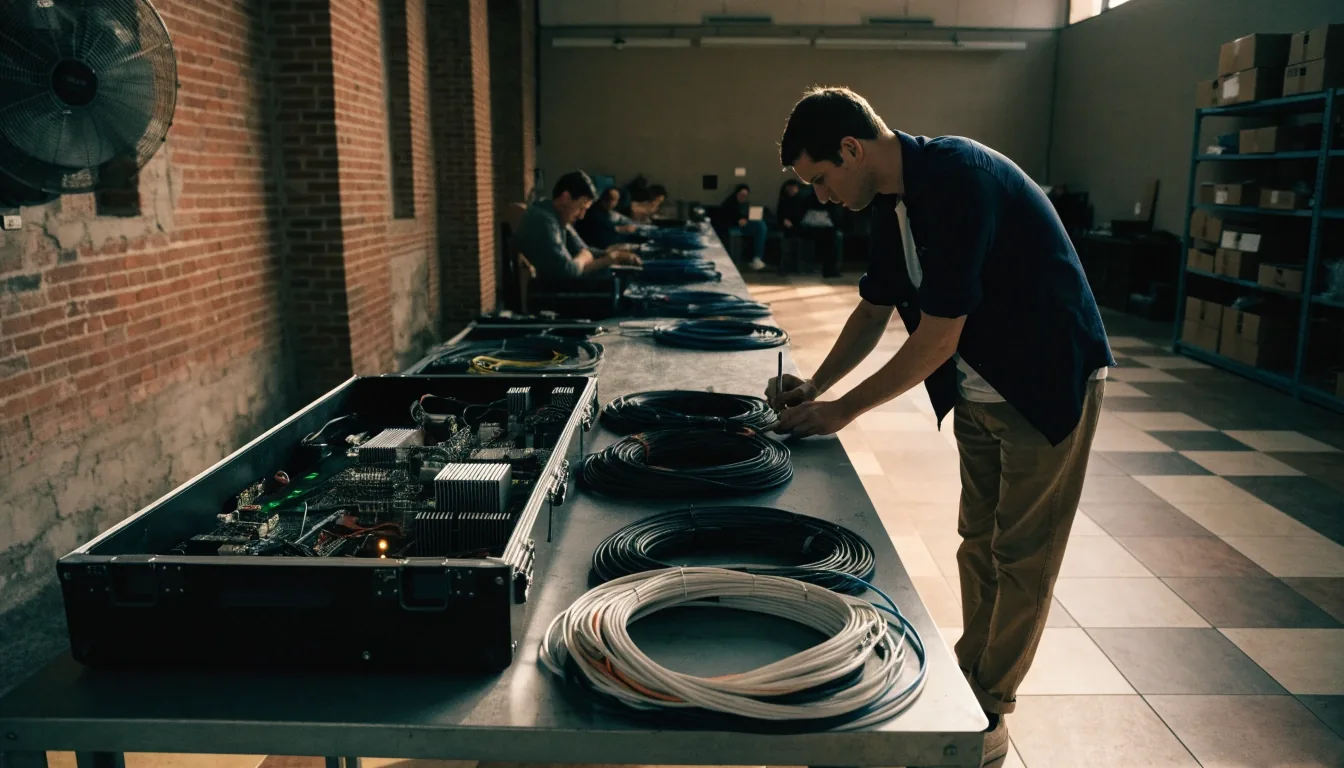
A dark Chicago loading street at low evening light with the dock approach of a South Loop software office

OUR PROCESS

A software delivery process built around decisions

Every team says it follows a process. What separates them is whether that process survives contact with reality. Ours is built around four decisions that decide whether a project succeeds or drags: what problem you are solving, who uses the result, what systems it touches, and how you will know it works.

WHAT THE PROCESS CARRIES

Why we build the process around decisions, not ceremonies

Discovery, architecture, design, delivery, quality, launch, and support are the seven phases we run on a custom software project. Read together, they answer the same four questions a buyer asks before signing: who decided what, when does the decision get made, what does it produce, and who owns it after the code ships. Sequence matters less than whether those decisions are still correct six months in.

The seven phases below are the working sequence Caxy Interactive runs on web platforms, internal tooling, and enterprise integrations. Each one carries a clear output, a named owner, and a point where it would be cheap to change course.

FOUR DECISIONS UP FRONT

The four questions every phase answers

What problem are we solving?

The first request rarely describes the real problem. Discovery is where we find out what the business actually needs the software to do, and what "done" means for the people who will use it daily.

Who uses the result?

Internal tooling and customer-facing products fail for different reasons. Knowing the audience shapes the interfaces we design and how much of the workflow the software should take over.

What systems does it touch?

Most enterprise software lives next to a CRM, an ERP, or a data warehouse that cannot move. Mapping those touchpoints early keeps architecture from becoming a rewrite in month three.

How do we know it works?

Without a stated success signal, "done" becomes an argument. We set the checkable measure before build starts, and revisit it at each short delivery cycle.

Seven phases, in the order we run them

Each row is a phase of the custom software development process we follow. Discovery, architecture, and design run first and in near sequence. Delivery, quality, launch, and support overlap as the build moves forward.

PHASE 1 · FIRST RUNS

Discovery: the phase that prevents most of the problems

Discovery is where we learn what you actually need, which is not always what the first request described. It involves interviews with the people who will use the software, a review of the systems involved, and a hard look at what is realistic. We are looking for the real constraints: the process that cannot change, the data that has to stay where it is, the deadline that is fixed. The output of discovery is not a document nobody reads. It is a shared understanding of scope and a plan we both believe in.

WHAT YOU GET

A written scope the business, the engineers, and the stakeholders all read the same way, plus a short list of constraints we will design around.

PHASE 2 · FIRST RUNS

Architecture: choosing the shape of the system

Before code, we decide what kind of system this should be. That covers the technology choices, how the pieces talk to each other, and how the system will be maintained after we are done. Architecture decisions are expensive to change later, so they are worth getting right early. We document the reasoning, not just the outcome, so future engineers understand why the system looks the way it does. A well-chosen architecture is one your team can still work with in five years.

WHAT YOU GET

An architecture decision record and diagrams that explain why each major technology and integration was chosen, in plain language.

PHASE 3 · FIRST RUNS

Design: built around the people who will use it

Software that works technically and fails with users is a common outcome when design is treated as decoration. We design interfaces by understanding the workflow first: what users are trying to accomplish, what data they need in front of them, and where the current process creates friction. For internal tools, this often means fewer features, not more. For customer-facing products, it means testing assumptions early. Design decisions get validated with real users when that is practical, and coded into the system when it is not.

WHAT YOU GET

A workflow map, wireframes, and interface components that match how the people doing the daily work actually move through the task.

PHASE 4 · BUILD RUNS OVERLAP

Delivery: how we actually ship

We work in short cycles with working software visible at the end of each one, not a big reveal months later. You see progress as it happens, and course corrections are cheap. Each cycle produces something you can review, test, or show to users. That rhythm keeps the project honest: problems surface while they are still small. It also means we can adjust priorities as your business changes, which it usually does.

WHAT YOU GET

A deployable build at the end of each cycle, plus a short written note on what changed, what is open, and what comes next.

PHASE 5 · BUILD RUNS OVERLAP

Quality: what "done" means on our projects

Code review, automated testing, and a working deployment pipeline are standard on our work. The point is not process for its own sake. It is that software needing manual, error-prone steps to release becomes a liability. Tests catch regressions before users do. Reviews keep quality consistent across the team. A clean deployment pipeline means a bug fix can ship the same day it is found. We treat these as table stakes because we have seen projects fail without them.

WHAT YOU GET

A review trail on every merge, a test suite that runs on each change, and a deployment pipeline that does not depend on one person's memory.

PHASE 6 · TAIL RUNS

Launch and the days after

Launch is the moment a system stops being a project and starts being infrastructure, and it is where a lot of teams disappear. We plan the transition: training, documentation, monitoring, and a clear path for support. What is more, we stay involved. Most systems need adjustments in the first weeks as real usage exposes assumptions. The goal is a clean handoff, whether that is to your internal team or to us for ongoing support.

WHAT YOU GET

Operator training, written runbooks, monitoring coverage on the critical paths, and a named route for issues in the first weeks.

PHASE 7 · TAIL RUNS

Support and long-term maintenance

Software lives longer than the project that created it. Systems we built years ago are still running, which means we have had to maintain our own work and learn what holds up. Support looks different by client: some want us to handle everything, others want to own the system and call us for specific work. We set that expectation early rather than at the end of a project. Whatever the arrangement, documentation and knowledge transfer matter, so you are never locked in.

WHAT YOU GET

A support arrangement agreed in writing, system documentation kept current, and a copy of every asset so you can run the system without us.

A hand-drawn architecture sketch on a workbench during a software project planning session in Chicago

SKETCH BEFORE CODE

No working system starts at the keyboard

Every phase leaves a written trail on purpose. The scope note from discovery, the architecture diagram, the workflow map, the deploy log from the last cycle, and the support handoff document all stay readable months later — so the reasoning behind a decision is still available when someone new picks up the system.

Scaling the team up and down

Projects rarely need the same team size throughout. Discovery needs a few people. Build phases need more. Support needs fewer. We staff to the project's actual needs rather than keeping a fixed team attached, and we bring in specialists when a specific problem calls for one. For clients, that means paying for the effort involved rather than a standing roster. It also means the people who built the system are usually still around when something needs changing.

Discovery and architecture

Small senior group. Two or three people working closely with your stakeholders, focused on getting the decisions right before anyone writes serious code.

Build and delivery

Expanded team. Designers, engineers, and a QA specialist working in short cycles, sized to the volume of platform work the project needs in the current phase.

Support and maintenance

Leaner crew. A reduced team keeps the system healthy, handles small changes, and pulls in the original builders when a deeper change is needed.

WHAT WORKING TOGETHER LOOKS LIKE

Communication, expectations, and handoffs

HOW WE MEET

Weekly rhythm, written record

A short check-in each week with what shipped, what is blocked, and what needs a decision. Written notes go out after, so nobody has to remember a call. If your team prefers daily standups during a tight phase, we join those and keep the same written trail.

WHO DECIDES

A named owner on both sides

One person on your side and one on ours, both named at project start. Architecture and platform choices are ours to propose, and the final call is yours. That split keeps technical trade-offs clear and keeps decisions from sitting in a queue.

WHAT YOU KEEP

Source code and documentation

You own the code, the design files, and the infrastructure accounts from day one. We work in your repositories when you have them. If you do not, we set them up under your name so nothing needs to be migrated off us later.

HOW CHANGE WORKS

Scope changes get named, not slipped in

Requests that fall outside the current cycle get written down, estimated, and slotted. A change that pushes the current cycle's date gets flagged before it is accepted, so trade-offs stay visible to both sides instead of surfacing at the end.

QUESTION LOG

Questions before the first phase

The questions we hear before a discovery kickoff. If yours is not here, take it to the contact page — answers come back in a day or two.

How long does discovery take?

Discovery runs two to four weeks on most projects. A tight internal tool with one integration moves faster; a platform touching a CRM, an ERP, and a data warehouse takes longer. We give a firmer range after the first stakeholder interview.

Do we have to start with discovery?

We recommend it, and we say why. Products that skip discovery usually pay the cost back as rework in month two or three — often as a rewrite of a core assumption nobody tested. If you already have a documented scope and architecture, we can start in architecture or design instead.

How do you handle a fixed deadline?

We plan backwards from the date and name what has to be in scope to make it. If the deadline and the full feature set cannot both hold, we show the trade-off early and let you pick the shape of the release instead of discovering the conflict later.

What if we already have an internal engineering team?

Common, and it works. We can run discovery and architecture, then hand off to your team, or work alongside them inside a shared cycle. Your engineers are in the same repositories and the same weekly rhythm from day one.

How does ongoing support get priced?

It depends on the arrangement. Some clients want a dedicated support window with us on call; others want a maintenance retainer that covers small changes and reviews. We set the expectation during discovery, not at handoff, so the cost is in the plan you approve.

CHICAGO CUSTOM SOFTWARE SINCE 1999

Start with a conversation

Bring the problem as you understand it today. We will tell you what discovery would cover, which decisions would need to land first, and whether this is a project we are the right team for. No pitch deck, no auto-generated estimate — a working conversation about the shape of the work.

Prefer to write first? The contact page opens with a short form.